Choose an AI App, Automation Platform, or API Workflow for Request Intake
Choose a request-intake setup by testing its input, review gate, destination update, failure handling, ownership and usage costs.
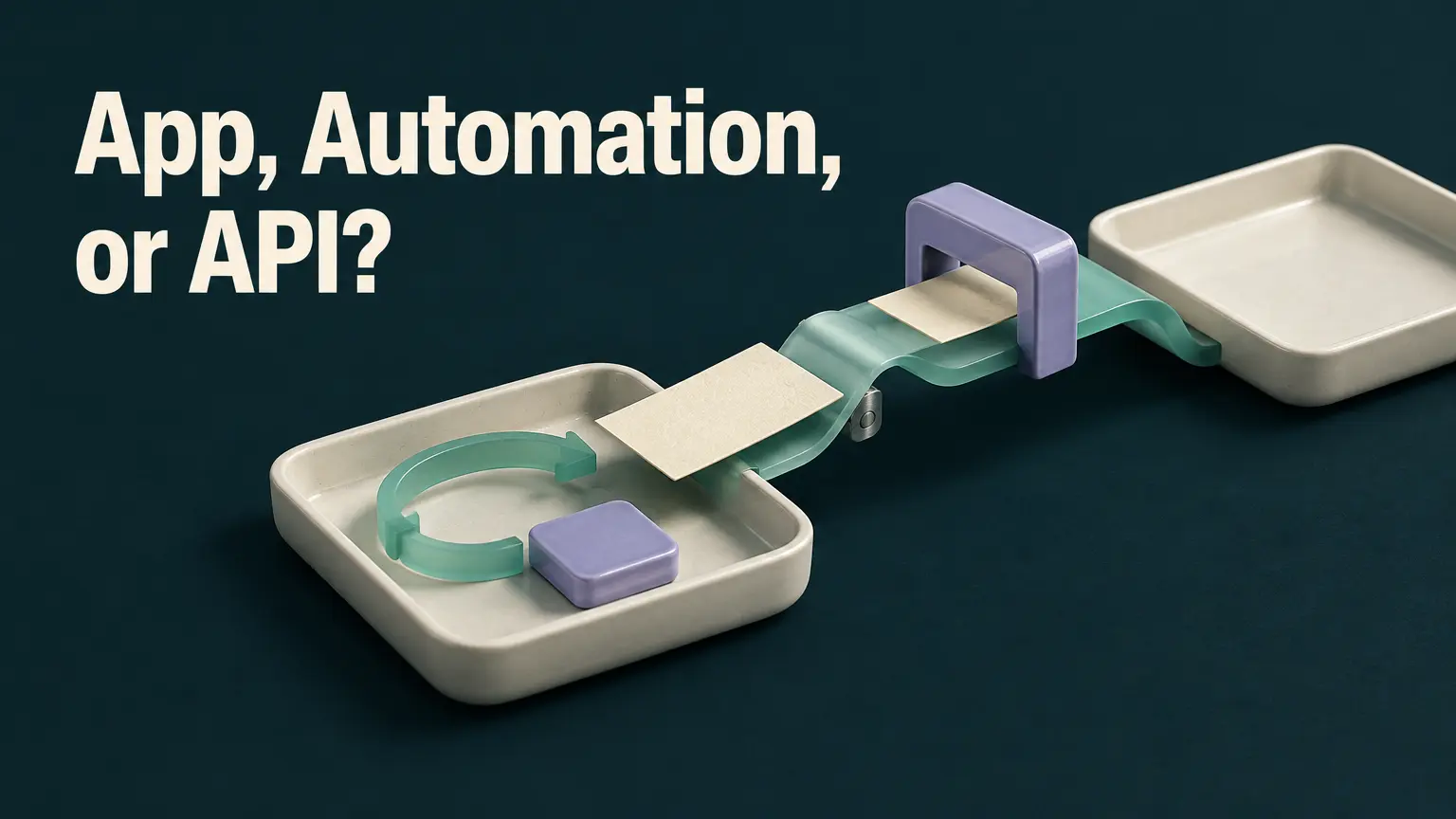
If requests arrive and can be reviewed, assigned and recorded in the app your team already uses, test that app first. If an event in one service must update another, test an automation platform. If the team needs to define service steps with explicit conditions, transformations, retries or error handling, consider an API-defined service workflow. These are setups to test against the task—not a ranking of AI capability. The right one receives the real input and completes the approved handoff without a surprise copy-and-paste step.
Map the handoff before choosing software
Write down six things for one request type:
- Trigger: What event starts the work? Can the candidate setup receive that event, rather than requiring someone to notice it?
- Input: What description, contact details and other information arrive? What information might be missing?
- AI’s role: Does AI propose a category, summarize a request or do something else? State what a rule or a person will do instead.
- Destination: Which record needs updating, and which fields must it contain? A proposed category is not an assignment or a completed handoff.
- Review gate: Who is authorized to approve or correct the category, and how is that person identified before the update? What happens if no reviewer is available?
- Failure path and owner: Who can see an unsuccessful update, resolve it and check for an existing assignment before retrying? Who owns changes to the setup?
Then check each candidate’s actual trigger, input access, review mechanism and destination action. Do not infer an approval gate from the presence of an AI step, or a working connection from a platform’s general integration claims. For example, Azure Logic Apps documents a trigger followed by actions; that describes a workflow mechanism, not proof that it supports this particular request source or destination.
Match the setup to the boundary
The existing AI-enabled app is the first candidate when intake, review and the next action can all stay there. Check whether the app can receive the actual request, expose the original to the reviewer, prevent an unapproved assignment and write every required field. If one of those steps needs a manual transfer to another service, the task does not stay in one app after all.
An automation platform is worth testing when the trigger and destination live in different services. Configure and test each connection and the order of actions: receive the request, propose a category if AI helps, obtain approval, then update the destination. The available mechanisms differ. n8n describes pre-built nodes and custom API connections, while Logic Apps documents triggers, actions and code extensions. An API connection or code extension inside a platform is not evidence that a separately built integration would work better.
An API-defined service workflow is a candidate when the team can specify and operate named steps and needs to test explicit conditions, data transformations, retries or errors. Google Cloud Workflows documents YAML or JSON steps, as well as those controls. Its HTTP callbacks are documented as useful for waiting for external systems and human-in-the-loop processes. Whether that mechanism can reach your request source, obtain the required approval and write the destination still needs a task-specific check. If you mean a bespoke integration rather than a documented orchestration service, assess that build separately; these platform capabilities do not establish when bespoke work is preferable or what it would entail.
Apply the checks to a request
Suppose a team receives a short request description and contact details. It wants a destination record containing an approved category, an assigned owner and, when the category needs review, a named reviewer. This is a hypothetical design, not a tested product configuration.
Before selecting a route, define how a reviewer is found—for example, from the team’s designated reviewer for that request type. Record the selected person’s name with the pending request. If no designated reviewer is available, send the request to manual triage instead of updating the destination. Define owner selection separately: before the update, apply a routing rule that maps the approved category to a named owner. If the rule yields no owner, send the request to manual triage rather than writing an incomplete assignment. A person compares every AI-proposed category with the original description and approves or corrects it; uncertain or incomplete requests get particular attention, but an AI-generated uncertainty flag is not the only gate. Only after approval does the setup assign the owner selected by that rule and write the approved category, owner and required reviewer name to the destination.
If intake and that gated update can happen in the existing app, test the in-app route. If intake happens elsewhere, test whether an automation platform can carry the request and reviewer decision across both services. For an API-defined service workflow, specify the same trigger, gate and destination fields as named steps and test its available waiting and error-handling mechanisms. None of these routes meets the requirement merely by producing a plausible label. If a candidate cannot identify a reviewer, hold the update for approval and record that reviewer where required, change the design or reject that candidate.
Test the failure path as well as the happy path
Try an ordinary request, one with missing details, an ambiguous one and a deliberately incorrect proposed category. Inspect what the setup actually receives, what the reviewer sees and what is written after approval. Remove the designated reviewer in a test: the request should reach manual triage, not silently acquire an owner. Test an approved category with no mapped owner, too: it should reach manual triage rather than produce an incomplete destination record. Then make a destination update fail. Can the team find the failure, resolve its cause and check whether an assignment already exists before retrying? Duplicate-safe behavior matters particularly where delivery can repeat: Logic Apps documents at-least-once message delivery.
Finally, name the person who will own the chosen configuration and identify its applicable app or platform, model and hosting usage costs. A free workflow builder need not mean free model usage or hosting, as Bit Flows’ comparison points out. Choose the setup only after it passes the real trigger, review, destination and recovery checks—not because its AI step looks impressive in isolation.